“Enthamaatramuna evvaru thalachina antha maatrame neevu...” (However much anyone thinks of you, to that extent you are...) is what I feel like quoting here. A beautiful devotional Carnatic Telugu Keerthana by the famous 15th century Saint poet Shri Annamacharya feels so real even today when you visit such temples. This temple, the CHANGUNARAYAN MANDIR epitomizes what Annamacharya sings. The Lord here appears as Vishnu, Shiva & Shakthi in various forms thereby satisfying the devoted Vaishnava, Shaiva, Bouddha and Shaaktha all at one place although the primary deity is Lord Vishnu. Also, unlike in my previous posts, I have not sketched the primary deity, but the ultimate form of Him the VISHWAROOPA which is one of the sculptures in this temple which I could not resist. This 4th century temple with beautiful intricate Nepal’s Lichchavi period architecture is a feast to the eyes. Let us travel into the world of extraordinary art, architecture and spiritualism all under one roof...
इहैकस्थं जगत्कृत्स्नं पश्याद्य सचराचरम् |
मम देहे गुडाकेश यच्चान्यद्द्रष्टुमिच्छसि ||
ihaika-sthaṁ jagat kṛitsnaṁ paśhyādya sa-charācharam
mama dehe guḍākeśha yach chānyad draṣhṭum ichchhasi
“Behold now, Arjuna, the entire universe, with everything moving and non-moving, assembled together in My universal form. Whatever else you wish to see, observe it all within this universal form.” (Srimad Bhagavad Gita – Chapter 11- Shloka -7)
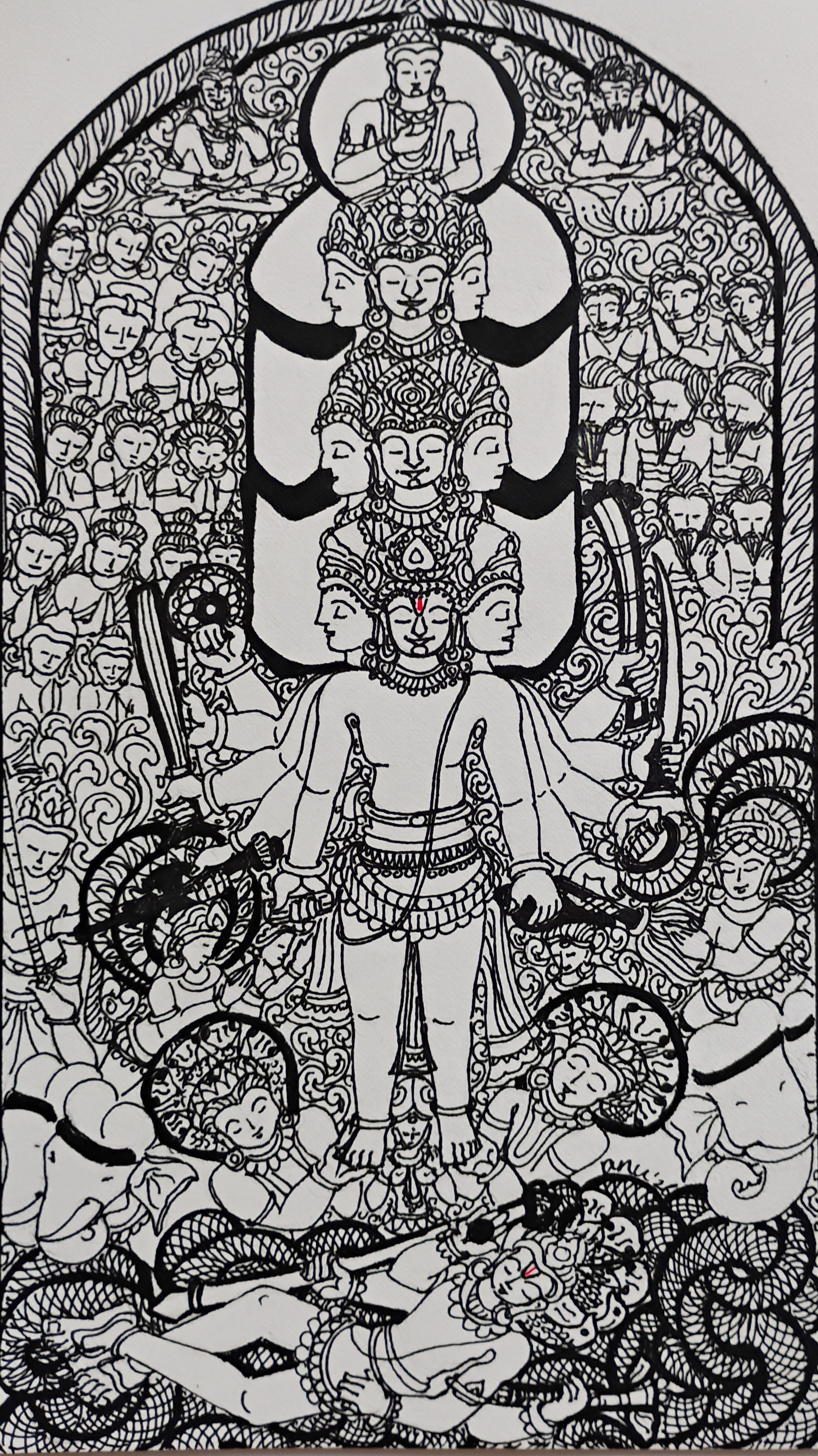
VISHNU VISHWAROOP, Low bass-relief sculpture, Changunarayan Temple
LOCATION:
CHANGUNARAYAN TEMPLE is located a few miles from the very famous, beautifu, artistic settlement called BHAKTAPUR, about 12 km east of KATHMANDU, NEPAL. The temple is on a small hill-top along the river Manohara. The path to the temple has stone steps on both sides of which are interesting small Art shops selling intricate wood works, stone sculptures, different types of Rudraksha beads and many other beautiful knick-knacks you can buy as souvenirs for friends at home.
MAIN DEITY:
This is GARUDA NARAYAN as he is called by the natives- you can see LORD MAHA VISHNU seated on Garuda as the primary deity of this temple. The Buddhist worship him as Hariharihari Vahan Lokeshwara (a form of Avalokiteshwara). The Lord is seen holding the Shankha (Conch), Chakra (Discus), Gadaa (Mace) and Padma (Lotus). The Moola Vigraha which is made out of Saligrama is all covered with flowers and here the access to see is strictly only to the temple priests, visitors are not permitted to see it directly. As if in compensation, the Lord is all over the temple and gives darshan to the devotees in various forms.
VISHNU VISHWAROOPA:
One form of Lord Vishnu far out of human capacity to visualise is the VISHWAROOPA. Although it is described in detail in the Mahabharatha in various Parvas and has a mention in the Harivamsha, Vishnudharmottara Purana, Satvata Samhitha and the Ahirbudhnya Samhitha to name a few, to recreate it through art or literature is an impossible task. But, when you see this low bass-relief sculpture in the Changunarayan Mandir, you are made to accept that human attempts with divine grace can make the impossible, possible. To call this sculpture an artistic marvel is a massive understatement.
What must the craftsman have felt while sculpting this wonder?! To see this and absorb itself feels overwhelming! It makes us think how Arjuna must have felt seeing the Pratyaksha Vishwaroopa which he describes in the Bhagavad Gita (Chapter 11). The infinite cosmic form of the Lord- boundless with no beginning , middle or end with all the Gods and creatures in all the Lokas and Brahmandaas, with innumerable heads, arms, stomachs, thighs, feet, mouths, terrifying teeth and eyes on all sides, with glowing, blazing power of immeasurable number of Suns, with all the divine astras in his countless hands, with Sun and Moon as eyes, this form that Arjuna saw with his divya-cakshu (divine vision given by the Lord) is the ultimate all-encompassing one which is terrifying to the Nara himself who begs to the Lord to come back to ‘his gentle human form’.
Such a Vishwaroopa you are blessed to see in this Kaliyuga through one’s mortal body and human eyes. This can happen only through the creation of an artist with divine grace. You feel so fortunate to have come across this Vishnu Vishwaroopa sculpture here. This bass-relief sculpture which is only 17 inches tall is an extraordinary composition which is divided into three distinct parts representing the three Lokas – Swarga, Bhoomi and Paatala.
The central figure, MAHA VISHNU, although small in size stands majestically with 9 heads and 10 arms. The artist has placed the heads in threes vertically thus giving space to fit in all the entities of the 3 Lokas making the composition more interesting and rhythmic. His many hands hold his sacred weapons, including the Sudarshana Chakra (discus) and the Panchajanya Shankha (conch).
The Upper level or the Swarga in the sculpture has all the Gods and Celestials. On the top most is seen Lord Shiva, Lord Brahma and Lord Indra. There are the Vidhyadharas and Rishis witnessing the Vishwaroopa. As you marvel at this extraordinary work of art, you keep wondering about the skill of the artist to place so many figurines in the background. On the Lord’s right are the Devas and on to his left are the Asuras sculpted to perfection.
The Middle level or the Prithvi in the sculpture the Lord is seen standing with his feet firmly planted on the “shoulders of the Earth,” personified as the goddess Prithivimatha (Bhoodevi). You can spot Arjuna with folded hands, the reason for this Vishwaroopa Darshan, near the feet of his Guru, Shri Krishna. Behind Arjuna is seen Garuda, his vahana with his majestic wings. Figures of humans and elephants are seen, which represent the diverse forms of earthly beings.
The Lower level or the Paathala in the sculpture has an interesting huge serpent sculpted intricately, the Adisesha. On him lies a beautiful reclining figure commonly mistaken for Lord Vishnu, yet another avatara, Balarama. Nagas are shown worshipping the Lord.
A true artist is never satisfied with his work and this is proved in this sculpture. As if the sculpting of these innumerable figures were not enough, the artist has filled the gaps with intricate floral designs and the borders too with details. Your gaze will never move away from this stunning sculpture where art brings the divine to life. But there is more for your eyes to feast on in the Changunarayan premises. So, we move on...
CHANDA NARAYAN: Just in front of the Garbhagriha we can see the Lord as CHANDA NARAYAN, a small but highly detailed 15” sculpture where Vishnu is seen riding on the shoulders of a humanoid Garuda carved out of a single slab of grey stone. The image of this beautiful 7th century Lichchavi period art work is featured on the Nepalese 10-rupee bank note.
As you marvel at the fluid lines of this very compact sculpture, you can see a contrasting 6 feet tall Garuda dating back to the 5th century Lichchavi period. This is the first time I am seeing a Garuda so unique that it resembles a human being except that it has wings. Garuda is seen kneeling on his right knee with a snake around his neck, with detailed wings, his hands in the Anjali Mudra (folding both hands doing namaskaram to his beloved Lord), carved from a single block of stone. It is one of the oldest and most artistically significant sculptures in the Kathmandu valley, representing the early transition of Garuda from a bird-like creature to a more human form in Nepalese art.
SRIDHARA VISHNU: A beautiful 9th-century stone sculpture of Vishnu, Lakshmi, and Garuda, standing on the pedestals of beautiful artistic motifs.
VAIKUNTA VISHNU: A 16th-century sculpture of Vishnu seated in Lalitaasan position on the six-armed Garuda and Lakshmi seated on the lap of her Lord.
VISHNU VIKRANTH: A 7th-century sculpture of the Lichchavi period, the Lord appears in his Trivikrama Avartara depicting the scene of placing his foot on King Mahabali’s head after measuring Bhoomi(earth) and aakasha (sky).
NARASIMHA: A 7th-century sculpture of the Lord in Narasimha Avatara, after killing the asura King Hiranyakashipu to save his beloved devotee Prahalad is another beautiful representation of Lord Vishnu in this temple.
OTHER DEITIES IN THE TEMPLE:
CHINNAMASTA DEVI: Hinduism is so diverse with deities that represent varied human emotions that one can connect easily and follow the knowledge they impart. Chinnamasta Devi is one such. She is one of the ten MAHAVIDHYAS, depicted with a red complexioned, fierce, nude form, holding her own severed head in one hand and a scimitar in another, hair dishevelled, wearing a skull garland. She stands upon a copulating couple, with blood flowing from her neck.
The Severed head represents the severing of ego and achieving spiritual wisdom, awakening the Kundalini Shakthi. Three streams of blood flow from her neck - one into her own mouth and two into her attendants Dhakini and Varnini, symbolising self-nourishment and the flow of energy from the Ida, Pingala and Sushumna nadis. The copulating couple that she is standing on are Kamadeva and Rathi, symbolising control over lust and desire.
This form of Shakti or Kali, associated with tremendous spiritual power and called as Prachanda Chandika (fierce Chandika) in Tantric worship is a rare visual to see.
KILESHWOR MAHADEV: This is a small two-storied temple of Lord Shiva, who is believed to have appeared in this place for the protection of the Changu hill.
HISTORY & STHALAPURANA:
This temple, which is built with a traditional Nepalese architecture, is believed to have been built in the 4th century AD and is one of the oldest Hindu temples in Nepal. It houses one of the oldest pillar inscriptions in Nepal made by a Lichhavi dynasty king Manadeva.
This temple finds its mention in an ancient book ‘BHASA VAMSAAVALI’. The interesting sthalapurana goes like this…
Long ago in the beautiful Himalayan ranges of Dolagiri, the original name of Changu Narayan hill, there was a small village in which a Brahmin named Sudarshan lived. Sudarshan was a well-disciplined man but was short-tempered. He owned a Kapila cow, one similar to the divine Kamadhenu, which produced immeasurable quantities of milk that he offered to his favourite deity Lord Vishnu. There was a big Champaka tree in the village. His cow would often go and sit under this tree. Suddenly the cow stopped giving milk. After seven days of not getting milk from Kapila, the Brahmin became angry and wanted to find out the reason.
He said, “I will not rest until I behead the one who dares drink the milk intended for sacred offerings.” He followed the cow and watched it from a hidden spot. There he saw a strange thing happen. A man emerged from the Champaka tree and began drinking the cow’s milk. In a fit of anger, the Brahmin drew his is sword and struck the man’s neck. At that moment, the man transformed, revealing himself to be none other than Lord Vishnu, who was now devoid of his head with his Shankha, Chakra, Gada, Padma seated on seated on Garuda. The Brahmin, realizing what he had done, was filled with immense remorse, lamenting, “What sin have I committed in a past life to have brought this upon myself?”
As the Brahmin was about to take his own life in repentance, Lord Narayana assured him, “Do not fear, O sage. You have no reason to grieve. Instead, abandon your fears and ask for a boon.” The Brahmin replied, “O Narayana, grant that the punishment for my sin of beheading you be delivered upon me by your discus.”
To this, Lord Narayana explained, “Listen, O sage. Long ago, in a battle with a demon named Chandra, his dear friend, a Brahmin named Sumati, was killed by a weapon I had launched. Due to his strong devotion, his guru, Shukracharya, cursed me that in the future, my head would be severed by a descendant of Sumati. This was destined to happen by your hand.”
Lord Narayana continued, “Thus, this was inevitable. Now I shall reside here as a severed head. Worship me here and offer me your prayers.” With these words, Lord Narayana disappeared.
That is how Lord Vishnu resides as Changu Narayan in this Kshethra permanently blessing all his devotees.
May Lord CHANGU NARAYAN bless us all.
Sarve Jana Sukhino Bhavantu.
ADDRESS:
CHANGU NARAYAN MANDIR
CHANGU NARAYAN MUNICIPALITY (44600)
BAGMATI ZONE,
BHAKTHAPUR, KATHMANDU,
NEPAL.
Image Source: Hand drawn sketch by me based on the photograph of the Deity.
Information Source: Bhakthas who have visited the temple, Internet and Self.
सर्वं कृष्णार्पणमस्तु
You are truly blessed to have visited this temple. I have no right to comment all I can say is I am blessed to read your posts and view your drawings sitting somewhere near the Arctic. 🙏